
Seeing pink? The lovely pink blooms that emerge on trees in the Pittsburgh area and Western Pennsylvania region in early April could be cherry blossoms…or they could be redbuds!
The Western Pennsylvania Conservancy plants cherry cultivars and native Eastern redbuds. Here’s some information about each tree and how to tell them apart.
Bloom Time (subject to change according to weather conditions)
- Cherry trees in Western Pennsylvania usually bloom in late March or early April, peak in early to mid April and fade by late April.
- Eastern redbud trees in Western Pennsylvania usually bloom in early to mid April, peak in mid April and fade by late April or early May.
Tree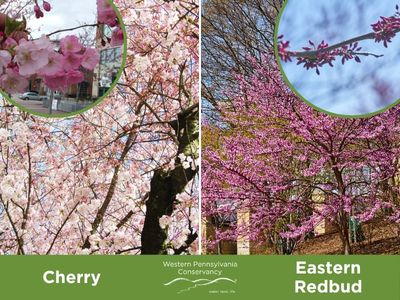
- Ornamental cherry trees (genus Prunus) are often planted with other trees in urban plantings on neighborhood streets and in parks. Many cherry cultivars (a plant produced by selective breeding) grow about 15 to 25 feet tall and have a spreading, often drooping, crown. Most cherry cultivars, while not native, are also not invasive. WPC does not plant any tree species recognized to be invasive in PA.
- Native Eastern redbud trees (Cercis canadensis), a member of the legume (pea/bean) family, are planted along Pittsburgh’s riverfronts and downtown through the Pittsburgh Redbud Project. To avoid a monoculture, they’re planted with complementary trees such as serviceberry. This native tree grows about 20 to 30 feet tall and has a broad, flat or rounded crown.
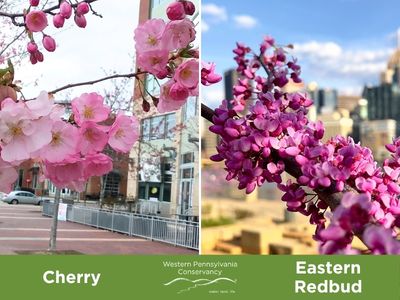 Flowers
- Cherry has dark pink buds opening to large, semi-double, pale pink flowers, before leaves appear.
- Eastern redbud has vibrant pink-purple or magenta pea-like flowers that emerge before leaves appear. The flowers appear all over the tree, even the trunk and main limbs, a phenomenon known as cauliflory.
Leaves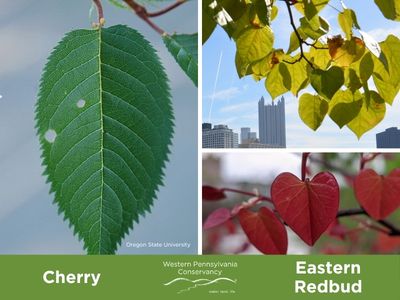
- Cherry has elongated, dark green leaves with serrated edges. In fall they can turn yellow to red.
- Eastern redbud has a large, heart-shaped green leaves that turn yellow, orange or red in fall.
Bark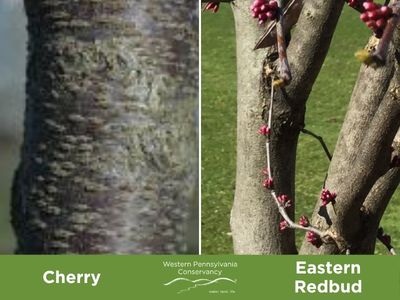
- Cherry has smooth, reddish-brown bark marked with horizontal lenticels (raised, corky spots) and becomes more textured with age.
- Eastern redbud has smooth, thin, gray-brown bark on young trees, turning to dark, scaly, and furrowed bark on mature trees.
Benefits to Pollinators, Wildlife, Landscape and Environment
- Cherries add beauty to the landscape and support pollinators, including many types of bees, with their early spring buds. They provide shade and improve air quality.
- Native Eastern redbud trees support many species of native bees, such as honeybees, carpenter bees, sweat bees and more, as well as other pollinators seeking early-spring food sources. The trees host the larval stage of some moths and butterflies. They provide shade and sequester carbon.
Cherry Fun Facts
- Unsprayed buds and flowers are edible but only in small amounts, as they do contain trace amounts of cyanogenic glycosides, which metabolize to cyanide.
- Even though it is a cherry tree, the accolade cherry tree shown in these images rarely produces fruit. It’s more prized for its beautiful, translucent flowers.
Eastern Redbud Fun Facts
- Also known as Judas Tree and spicewood
- Unsprayed buds and flowers are edible and can be used in baking, cooking and salads.
- Each April, Pittsburgh’s riverfronts and part of the downtown area are awash in pink Eastern redbud blooms, thanks to the Pittsburgh Redbud Project, a WPC initiative that began in 2016 with funding from the Colcom Foundation. With partners and volunteers, we have planted more than 3,770 native redbuds and complementary trees, as well as nearly 12,000 native perennial shrubs and grasses!