



Alysha Trexler
Raising grass-fed beef on her rural Indiana County farm isn’t just a side-job for Alysha Trexler — it’s a living example of a farm integrating conservation practices. So when the WPC watershed project manager talks with farmers and other landowners about how they can help improve water quality, she’s got street-cred — or farm-cred, as the case may be.
“I like to talk to people about what they love,” she says, “and help them connect what they love to what needs done to improve or protect it.”
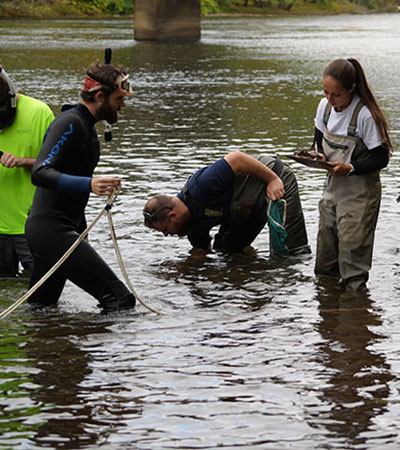
Alysha’s wide-ranging role includes water quality and biological monitoring, physical stream habitat assessment, agriculture best management practice and nutrient management development, riparian habitat improvement design and installation, and public education and outreach. She’s currently managing a multi-year riparian restoration project that utilizes all of those roles.
After serving with WPC as an AmeriCorps in watershed in 2003 and 2004, Alysha became an employee in 2005. She holds a bachelor science in biology with a chemistry minor from Indiana University of Pennsylvania, and has SCUBA and PA Nutrient Management certifications.
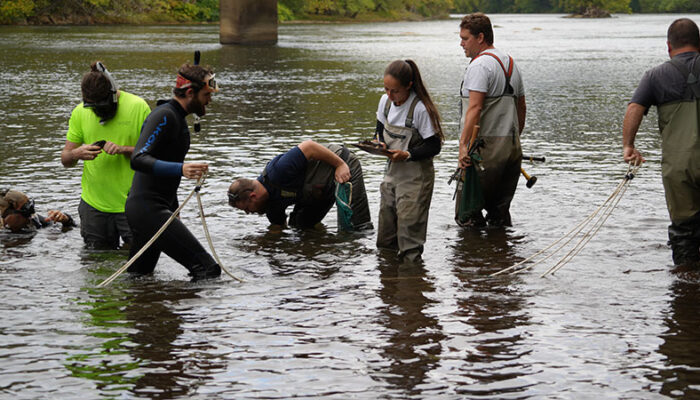
The seasons drive her schedule and projects. In spring and fall, she plants trees for riparian projects. Warmer months find her “out in streams assisting with fresh water mussel, hellbender salamander or fish surveys.” In between field work, she speaks with students and partners about improving and protecting water quality and meets with landowners about projects.
Sometimes that means reeducating people or dispelling misconceptions.
“Encouraging the public to support water quality improvement is challenging,” she says. “One cannot always ‘see’ polluted water become cleaner as it flows through the roots of trees. The polluted water appears clear– and clear can be misinterpreted as clean.”
Even defining what constitutes a stream is important. “A landowner might have a stream in very poor condition flowing through their property, but if they think it’s ‘just a ditch,’ they won’t think that it needs improved or protected!”
It all worth it, she says, knowing she is “helping the agriculture community see that conservation and farming don’t compete with each other.”
Charlie Spence
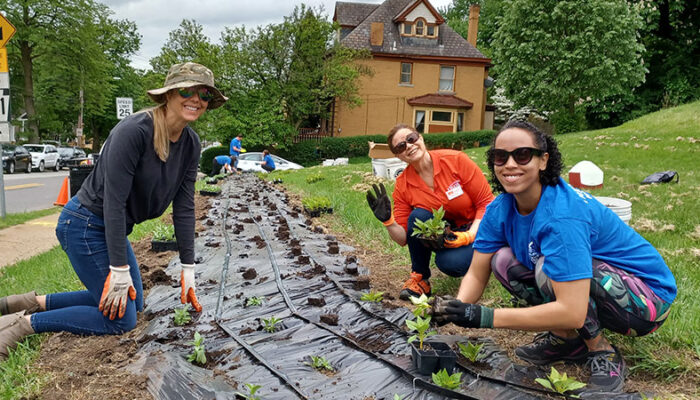
Growing things is in Charlie Spence’s blood, thanks to growing up with parents who were avid gardeners. He has lent his passion and expertise to the community flower garden in Clairton as the volunteer garden steward, even leading the installation of a pollinator-friendly section that attracts bees and butterflies.
What year did you begin volunteering with us and what motivates you to stay involved?
2012. The Clairton garden had been sorely neglected and needed a steward, I jumped at the chance. And why? To watch a strip of dirt turn into an incredible blooming garden is very rewarding.
How did you first become involved with WPC?
I ran into the woman who had been WPC’s Garden Volunteer Coordinator at another meeting. The Clairton garden needed a steward…next thing I knew, I had a garden.
What has surprised you most about working with WPC?
The true enjoyment of working not only with my garden and my team of dedicated volunteers, but also working with the staff. They are wonderful people who are always willing to lend a hand. As my schedule permits, I also enjoy showing up at other gardens to lend a hand, get some ideas for my own garden and meet new people.
Tell us about your favorite volunteer experience at WPC.
The thing I enjoy most about volunteering with WPC is working with a garden in a heavily polluted location that, despite the odds, thrives every single year, and provides a bright spot in an otherwise gritty industrial area”
What advice do you have for someone who is considering volunteering for WPC?
Take the plunge! Call and ask where you can help. You meet new people and get gardening tips. Honestly, just have a lot of fun. At my garden we laugh the whole time.
What do you do when you’re not volunteering (such as other hobbies or work)?
I have a medium-sized yard, with a garden that I have nurtured, planned and re-arranged for about 35 years. I love to read, love to travel. Although I am retired, I am involved with a few other non-profits that operate in the Pittsburgh region, serving on their boards, so I keep quite busy.
What might we be surprised to know about you?
I am addicted to Netflix, preferably watching foreign movies and TV series.
Hannah Poskin
A gardener’s work – and education – is never truly complete.
Hannah Poskin, a community greening field technician who has been with the Conservancy since 2025, appreciates the challenges, opportunities and lessons Pennsylvania’s changing seasons provide. “I get to learn something new from each season that comes along.”
Even during winter, when most plants in Western Pennsylvania often lie dormant under a blanket of snow, Hannah and her coworkers are learning and planning. During a recent winter, she worked on research for “high-impact perennial pollinators for the surrounding Pittsburgh region’s garden beds.”
Hannah has experienced the calm and the fury of all seasons, from bitter cold and heavy snow and rains and wild temperature swings, to breathtaking heat and humidity. She lifts, bends, stretches and carries heavy plants across environments ranging from grassy lawn to concrete while sometimes navigating traffic and crowds. (When the going gets tough, Hannah, an accomplished violin player of 13 years, listens to music to stay pumped!)
In her position as a self-described “hands-on gardener for the local Pittsburgh region,” she plants trees, tends gardens, removes trash and replaces plants in street planters in downtown Pittsburgh and more.
She has assisted with caring for pumpkin patches as part of school grounds greening projects. At least once a week, Hannah helps with tree plantings and maintenance, which includes pruning, stake removals and bark guard removals.
During peak seasons, vital work includes planting community flower garden plantings and downtown street planters. “We do a lot of behind-the-scenes and prep work to prepare for (downtown and other) events!” Hannah notes. “Plus there are other projects in between, such as hanging baskets and downtown plant removal and installations.”
Hannah has a B.S. in Geography (concentration in Environmental Studies and Sustainability), but the learning never ends. “This is a great position to learn names of plants and trees, how to tend to a garden and plant a tree, irrigation and so much more …information that is not only useful at work, but at home as well.”
The physical demands can be tough, Hannah admits, but worth it. It’s easy to stay inspired because, as her mom has shown her, “If I do what I love, success and happiness always follows.”
And, she adds, “It’s inspirational to see the trees or gardens grow, knowing that all my hard work helps the local communities and the environment.”
Want to get inspired like Hannah? Here’s her advice:
- “If you have any space, start planting native plants, however you can, to attract pollinators and more native life to Pittsburgh. “
- “Clean up your local trash. It makes a huge difference for not just you, but the ecosystem too.”
- “Join us for a WPC volunteer event – we can show you the way!”
Jeff Perrier
Some destinations are worth the long haul!
A semi-retired structural engineer with a focus on doing structural designs for architects, Jeff Perrier couldn’t wait to volunteer at Fallingwater as soon as he retired from full-time employment. Even though that means commuting from his residence in Jamestown, North Carolina!
As an Ask-Me Guide at “the View,” (the overlook area where people observe the house from afar and have their photos taken), Jeff especially enjoys talking with architecture students as they discover the site.
How did you become involved with Fallingwater and what motivates you to stay involved? Growing up in Pittsburgh, I have admired Frank Lloyd Wright and particularly Fallingwater since my early teens.
My career was focused on doing structural designs for architects and I have had the honor of working for several well-known architects including Aaron Green and Robert A. M. Stern. I still have family ties in Pittsburgh, so I resolved to volunteer at Fallingwater the moment I retired from full-time employment.
What has been most challenging or rewarding about volunteering?
Most challenging is the logistics of traveling from North Carolina. Everything is rewarding, but I really enjoy getting into varied conversations with such diverse groups of visitors.
Tell us about your favorite volunteer experience at Fallingwater.
I have had a number of potential favorites, but probably the best are in-depth conversations with prospective students of architecture.
What advice do you have for someone who is considering volunteering?
Learn everything you can, and enjoy meeting people.
What do you do when you’re not volunteering with Fallingwater?
Mostly music, focused on choral singing. Still working contract jobs and caring for three houses.
Kellie Liston
Usually the first thing people notice when driving by a WPC community flower garden are the colorful blooms. After a couple more passes, they notice the garden signs, which thank and acknowledge our generous sponsors…the businesses and people that make the gardens possible.
But Kellie Liston’s job is all about relationships. During her inaugural WPC volunteer events, Kellie noticed the sponsor names right away…and recognized many as businesses with which she works every day. Joining WPC’s Emerging Leaders Advisory Committee in 2025 was a natural progression for the Butler County resident.
What is your career?
Middle Market Relationship Manager at KeyBank. I manage a portfolio of businesses with $20 million or more in annual revenues to provide a suite of financial services including lending, treasury and capital markets capabilities.
How did you become involved with WPC and what motivates you to stay connected?
I became involved with the WPC through a work group volunteering event. It was through this experience that I began noticing all of the WPC community gardens located throughout Western PA.
In my role as a Relationship Manager at KeyBank, I travel to businesses also located in this footprint – I noticed an overlap of support between the businesses I work with every day and WPC, often through sponsored gardens.
The opportunity to join the ELAC has given me a closer look into all of the work done by the Conservancy and I’ve enjoyed making connections and staying active in the community. There are so many ways to become involved. I enjoy being out in nature every chance I can!
What might we be surprised to know about you?
People are often surprised to learn that I am a hunter. I’m from a small town in Northwestern Pennsylvania and have gone deer hunting every year since I was 12. This plays a big role in my interest in WPC since conservation efforts ensure that hunting can be done sustainably into the future.
What parts of WPC’s work resonate with you?
- Community Gardens
- Community Forestry
- Land Conservation
- Land Stewardship
- Fallingwater
What are some conservation issues that interest or concern you?
- Climate Change
- Habitat Loss
- Watershed Restoration
- Pollinator Support
- Endangered or Threatened Species
- Invasive Species
- Forest Connectivity
- Biodiversity
- Preservation of Fallingwater
Max Adzema
Through his office windows in the Gardener’s Cottage at Fallingwater, Max Adzema enjoys a view of a meadow where flowers wave in the breeze, birds sing from a hidden perch in a cherry tree and deer occasionally wander through to drink from nearby Bear Run. “It changes every hour and is quite calming,” he says.
Many would agree that Max deserves a bit of tranquility each day — as the public programs manager for Fallingwater’s education department, he manages a team of 43 people! Besides preparing a complex weekly schedule, he provides support for team members so they can focus on leading quality tours and programs.
“I’m making decisions and setting goals for what quality means,” Max explains, noting that Edgar Kaufmann jr. had many ideas on what a quality tour would look like, and Fallingwater’s educators continue to follow Kaufmann’s lead. “He felt that Fallingwater spoke for itself and we as caretakers can help guide visitors to find their own inspiration. Finding the right balance of information, conversation and quiet is something our team is trying to do now.”
During the pandemic, the team revisited its approach to tours to focus on helping visitors actively interpret and relate to the house, rather than listening passively to a tour guide lecture about the site’s history. “A continuously changing set of procedures needs to be refined, learned from and communicated,” says Max.
Even during Fallingwater’s short closure during each winter, Max is working hard, interviewing and hiring educators to lead tours and other educational programming, and scheduling and leading pre-season training classes. It’s rewarding work. “I love the people I work with, who are all so like-minded and dedicated to our site and organization.”
With his easy smile and kind demeanor, Max is a natural educator. “I love the visitors I meet who are drawn to this special place!” If he’s lucky, he gets to lead a tour here and there!
Max’s curiosity, combined with a love for architecture (he has a Bachelor’s in History of Art and Architecture from the University of Pittsburgh with a Museum Studies minor) and his love for nature (he enjoys camping, hiking and boating) make him right at home at Fallingwater, where he’s worked since 2016.
“I love being among nature that changes every day, and art that reflects that,” he says. Max invites everyone to share that unique experience. “If you have not taken a tour of Fallingwater recently, come visit!”
Nancy Levine
It started with an effort to get a single tree planted in a front yard.
A large red maple needed to be removed from the sidewalk of Dr. Nancy Levine’s Highland Park home in 2007. She was disappointed to see the old tree come down and wanted to replace it, but quickly learned it’s quite a process to purchase a tree and get approval from the city to plant it near the street.
After much research, Nancy applied for a street tree through TreeVitalize Pittsburgh, a partnership among WPC, Tree Pittsburgh, Allegheny County Parks, the City of Pittsburgh and the PA Department of Conservation and Natural Resources.
Nancy was already familiar with the Conservancy. When she moved to Pittsburgh in 1992 to take on the role of Director of Family Practice Residencies at West Penn Hospital, she volunteered with colleagues to plant WPC’s Highland Park Bridge flower garden and became a Conservancy member.
After getting trees planted on her street, Nancy focused on reforesting Highland Park! For the next seven years, not only did she complete and submit all of the applications for street trees in Highland Park, but she mobilized large teams of volunteers for plantings and created schedules for tree care and pruning. Her applications led to more than 500 trees planted in Highland Park!
Once, she finished a tree application on her way to catch a flight to Mexico, working furiously to meet the deadline while stuck in standstill traffic on the 31st Street Bridge. She submitted the application in the nick of time and still caught her flight!
She became a volunteer Tree Tender and recruited others. Tree tenders learn to plant, monitor and care for street trees to ensure survival.
Nancy traces her love for nature and passion for conservation to her childhood in Europe. She loved exploring the natural world, and cites Rachel Carson as her childhood heroine.
Now retired, she has more time to enjoy biking, kayaking and swimming. Nancy included WPC in her estate plans because she feels strongly about all the work the Conservancy does…but trees remain her true passion.
“I feel climate change is the biggest existential crisis facing us today,” she says. “Aside from all of us making big changes and sweeping legislation, I believe the best way to combat climate change is by planting more trees.”
Ultimately, she hopes her gifts enable the Conservancy to “keep doing what we’re doing, and more of it: planting trees, cleaning up water and educating the next generations on the importance of this work.”
Rhonda Mariotti
It’s not about the paycheck. It’s about the passion!
As a membership representative at Fallingwater, Rhonda Mariotti knows that people can sense when your job is, well…just a job. “When you speak with people, they can tell if you care for Fallingwater,” she says. “You really need to love the house.”
So dedicated is Rhonda to ensuring that people realize her passion for Fallingwater that she keeps a book by William A. Storrer, a scholar of Frank Lloyd Wright, that helped her learn about Wright’s works. When owners of other Wright homes visit, she invites them to sign the book, which she calls her “Fallingwater bible.” And, she says, “I really love it when my younger co-workers look at the book.”
The self-proclaimed “Wright nerd” came to Fallingwater later in life than many employees do. Now 73, she started working at the site in 2012. (Rhonda Mariotti Fun Fact: Sometime before that, she served in the U.S. Army for five years!)
“My young co-workers call me Granny and treat me with such respect,” she says. “We all love our job, which is raising money for the house, and sharing and learning about Wright and stories about the Kaufmanns and their guests.”
Rhonda’s face lights up at the mention of visitors. She loves to talk with them about the historic site she’s helping to protect. “You can see the passion in their faces,” she says, “and I love hearing about the other Wright buildings and houses they’ve been to.” To converse more fluidly with people, she says, “I tried to learn most of Wright sites and what states they are in. Speaking with our visitors helps me to remember!”
Rhonda knows that when people become Fallingwater members, they want to see Wright’s masterpiece cared for. So she goes to work each day inspired by “knowing that I am helping a World Heritage Site live on for younger generations.”
Steve Parks and Angela Ludwig
“Our land is a gift, as are its natural resources,” says longtime WPC member Steve Parks. “It must be protected and nurtured, so naturally, the Conservancy’s goals align with my own.”
While growing up in Huntingdon, Pennsylvania, Steve was surrounded by wooded hills bisected by the Juniata River. He spent his time hiking, fishing, climbing anything vertical and building makeshift cabins and treehouses. This exploration left him confident that nothing is better than all nature has to offer — forests, fields, streams and animals.
After studying landscape architecture at Penn State University, Steve began his career as a landscape architect/park planner with the National Park Service and in 1974 opened his own practice in Hollidaysburg. After a trip to Fallingwater, he became a Western Pennsylvania Conservancy member and has since become an ardent supporter.
Steve’s wife, Angela Ludwig, shares Steve’s passion for the environment. Growing up in a village on Lake Constance on the Swiss border, Angela was accustomed to spectacular landscapes. “I’ve learned that the land ethic in Germany is respectful and protective of all natural resources,” Steve says. “I was impressed by her insight into the natural environment and how important it is to people.”
Steve retired in 2025. He actively advocates for the environment, writing elected officials to share the importance of protecting our natural resources. He still explores the landscape, including by flying over Pennsylvania’s ridges and valleys (he has his pilot’s license). “You can clearly appreciate the topography, forests, streams and cultivated valleys. In any season there is beauty and wonder.”
Steve believes that educational outreach, particularly in public schools, sparks passionate interest and involvement and “should bring long-term benefits to our efforts to protect our natural resources.”
He includes the Conservancy in his estate plans as an expression of his life’s dedication to Western Pennsylvania ‘s landscapes, and as an intentional way for future generations to experience and care about nature.